
Classifieds site for the sale of historic, vintage, and collectible vehicles
Vintage cars for sale
Historic cars for sale
Collectible cars for sale
Vintage motorcycles for sale
NEED HELP?
help@mithosmarket.com
OPENING HOURS
Monday - Friday: 09:00 - 17:30
Saturday - Sunday: CLOSED



British Leyland Mini 1000 MkIV
Mr. Bean TV Series
This article is about the original television programme. For the title character, see Mr. Bean (character). For the animated spinoff, see Mr. Bean: The Animated Series. For other uses, see Mr. Bean (disambiguation).Mr. Bean is a British sitcom created by Rowan Atkinson and Richard Curtis, produced by Tiger Aspect Productions and starring Atkinson as the title character. The sitcom consists of 15 episodes that were co-written by Atkinson alongside Curtis and Robin Driscoll; the pilot episode was co-written by Ben Elton. The series originally aired on ITV, beginning with the pilot episode on 1 January 1990[1] and ending with "The Best Bits of Mr. Bean" on 15 December 1995.Based on a character developed by Atkinson while he was studying for his master's degree at the University of Oxford, the series centres on Mr. Bean, described by Atkinson as "a child in a grown man's body", as he solves various problems presented by everyday tasks and often causes disruption in the process. The series has been influenced by physical comedy actors such as Jacques Tati and those from early silent films.During its original five-year run, Mr. Bean was met with widespread acclaim and attracted large television audiences. The series was viewed by 18.74 million viewers for the episode "The Trouble with Mr. Bean" and has received a number of international awards, including the Rose d'Or. The series has since been sold in 245 territories worldwide. It has inspired an animated spin-off and two theatrical feature-length films along with Atkinson reprising his role as Mr. Bean for a performance at the London 2012 Summer Olympics opening ceremony, television commercials and several sketches for Comic Relief. The programme carries strong appeal in hundreds of territories worldwide because, in addition to the acclaim from its original run, it uses very little intelligible dialogue, making it accessible to people who know little or no English.
Origin
The character of Mr. Bean was developed while Rowan Atkinson was studying for his master's degree in electrical engineering at The Queen's College, Oxford. A sketch featuring Bean was shown at the Edinburgh Fringe in the early 1980s. A similar character called Robert Box, also played by Atkinson, appeared in the one-off 1979 ITV sitcom Canned Laughter which also featured routines used in the motion picture in 1997.
One of Bean's earliest appearances occurred at the "Just for Laughs" comedy festival in Montreal, Quebec, Canada, in 1987. When programme coordinators were scheduling him into the festival programme, Atkinson insisted that he perform on the French-speaking bill rather than the English-speaking programme. Having no French dialogue in his act at all, programme coordinators could not understand why Atkinson wanted to perform on the French bill instead. As it turned out, Atkinson's act at the festival was a test platform for his character and he wanted to see how his character's physical comedy would fare on an international stage with a non-English speaking audience.
The character's name was not decided until after the first episode had been produced; a number of other vegetable-influenced names such as "Mr. Cauliflower" were explored. Atkinson cited the earlier comedy character Monsieur Hulot, created by French comedian and director Jacques Tati, as an influence on the character.Atkinson also cited the influence of Peter Sellers, who had previously played similar "fumbling fool" characters, notably Hrundi Bakshi in The Party (1968) and Inspector Clouseau in The Pink Panther films. Stylistically, Mr. Bean is also similar to early silent films, relying purely upon physical comedy with Mr. Bean speaking very little dialogue (although like other live-action sitcoms during this period, it featured a laugh track). This has allowed the series to be sold worldwide without any significant changes to dialogue. In November 2012, Atkinson told The Daily Telegraph of his intentions to retire the character, stating that "someone in their fifties being childlike becomes a little sad." In 2016, however, Atkinson changed his mind by saying that he would never retire playing Mr. Bean.
Characters and recurring props
Mr. Bean
 Rowan Atkinson portraying Mr. Bean in August 1997
The title character and protagonist, played by Rowan Atkinson, is a childish buffoon who brings various unusual schemes and contrivances to everyday tasks. He lives alone at the address of Flat 2, 12 Arbour Road, Highbury, and is almost always seen in his trademark tweed jacket and a skinny red tie. He also usually wears a digital calculator watch. Mr. Bean rarely speaks, and when he does, it is generally only a few mumbled words which are in a comically low-pitched voice. His first name (he names himself "Bean" to others) and profession, if any, are never mentioned. In the first film adaptation, "Mr." appears on his passport in the "first name" field and he is shown employed as a guard at London's National Gallery.
Mr. Bean often seems unaware of basic aspects of the way the world works, and the programme usually features his attempts at what would normally be considered simple activities, such as going swimming, using a television set, interior decorating or going to church. The humour largely comes from his original (and often absurd) solutions to problems and his total disregard for others when solving them, and his pettiness and occasional malevolence.
In the title sequence of episode two, Mr. Bean falls from the sky in a beam of light accompanied by a choir singing Ecce homo qui est faba ("Behold the man who is a bean") which was sung by the Southwark Cathedral choir in 1990. The opening sequence was initially in black and white in episodes two and three, which was intended by the producers to show his status as an "ordinary man cast into the spotlight". However, later episodes showed Mr. Bean dropping from the night sky in a deserted London street against the backdrop of St. Paul's Cathedral. At the end of episodes three and six, he is also shown being sucked right back up into the sky in the respective background scenes (the black scene in episode 3 and street scene in episode 6). Regarding the opening credits, Atkinson has acknowledged that Bean "has a slightly alien aspect to him".[14] In the Mr. Bean: The Animated Series episode "Double Trouble", the alien aspect of him was used in a storyline in which he is taken inside a spacecraft with aliens who look exactly like him and even have their own plushy toys. In an obvious homage towards the end, the aliens send him back home in a beam of light and music similar to the opening of the original Mr. Bean series. Whether Bean is an extraterrestrial is not made clear.
Irma Gobb
Mr. Bean's long-suffering girlfriend, Irma Gobb (played by Matilda Ziegler), appears in three episodes. In "The Curse of Mr. Bean" and "Mr. Bean Goes to Town", the character is simply credited as "the girlfriend". She is treated relatively inconsiderately by Bean, who appears to regard her more as a friend and companion rather than as a love interest. However, he does become jealous when she dances with another man at a disco in "Mr. Bean Goes to Town", and she certainly expects him to propose to her on Christmas Day in "Merry Christmas, Mr. Bean"; his failure to do so results in her leaving him for good. Despite this, she later reappears in Mr. Bean: The Animated Series. It is revealed in the book Mr. Bean's Diary that her name is Irma Gobb and she works as a librarian at the local library.
In the Comic Relief sketch "Torvill & Bean", Bean is accompanied by a female companion portrayed by Sophie Thompson whose overall appearance resembles Gobb's.
Teddy
Teddy is Mr. Bean's teddy bear and, apparently, best friend. This little brown bear is a knitted oddity with button eyes and sausage-shaped limbs which invariably end up broken in half or in various other states of destruction and disfiguration. Although Teddy is inanimate, Mr. Bean often pretends it is alive: he always buys it a Christmas present or tries not to wake it up in the morning. For example, when Mr. Bean hypnotizes Teddy, he snaps his fingers and the bear's head falls backwards as if it had fallen asleep instantly. (Bean used his finger to prop Teddy's head up.) Teddy is often privy to Mr. Bean's various schemes and doubles as a tool or other items in emergencies; it has been decapitated ("Mr. Bean in Room 426"), used as his paint brush ("Do-It-Yourself Mr. Bean") and shrunk in the wash ("Tee Off, Mr. Bean"). Teddy is also Mr. Bean's "pet" in "Hair by Mr. Bean of London" where he is used to win a pet show.
Over the years, Teddy has undergone several changes. When it debuted on "The Trouble with Mr. Bean", it had a smaller head. Two episodes later, its head reached its current size but its "eyes" were not present until Bean placed gold thumb tacks on its face. The "eyes" have since been replaced with two small white buttons sewn over Teddy's face, giving it a distinctive image.
After filming ended, Teddy was donated by Atkinson to Gyles Brandreth's Teddy bear museum in Stratford-upon-Avon. In 2008 upon the museum's closing, Teddy was sold at auction for £180.
The Mini
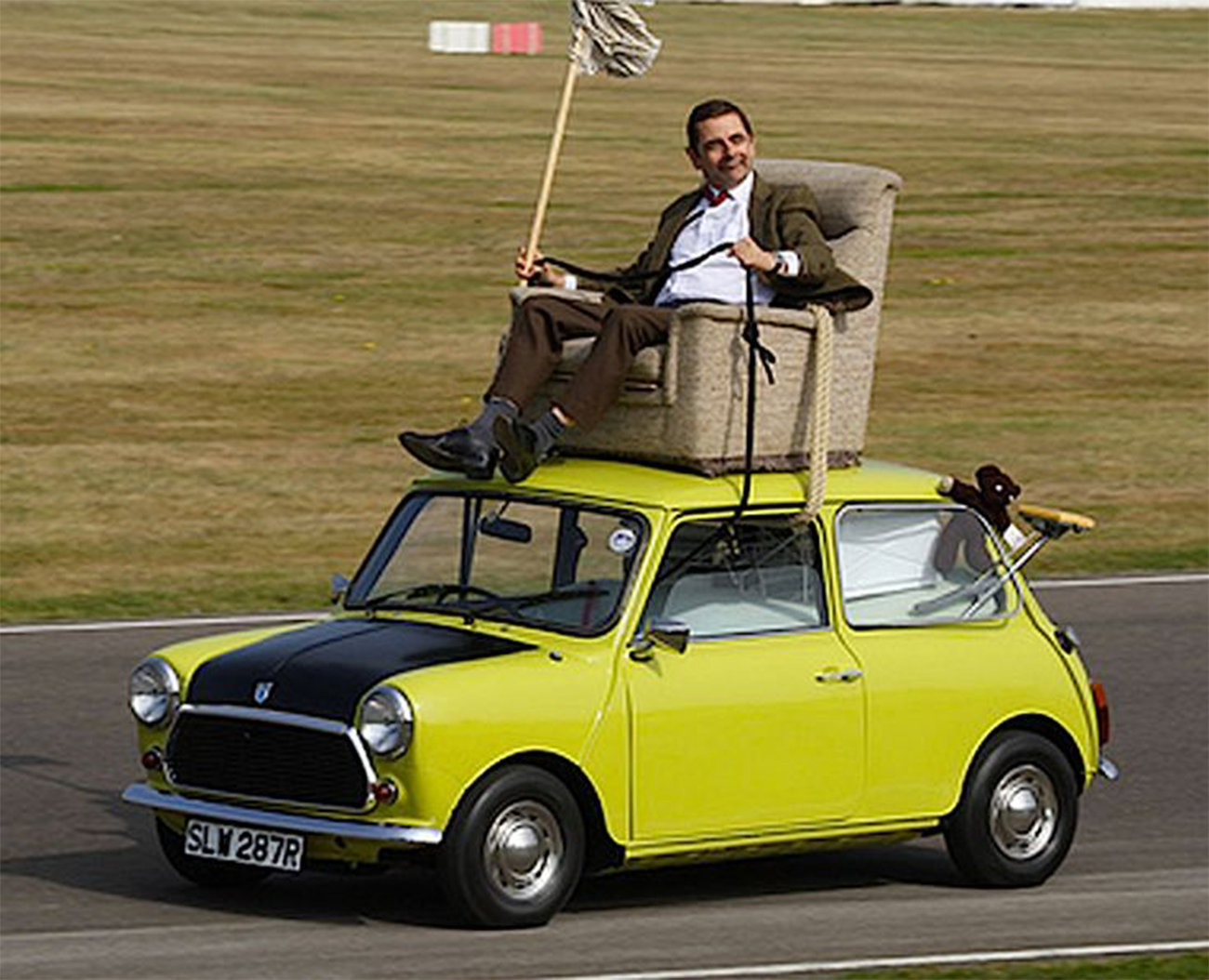
 Rowan Atkinson re-enacting a famous scene from the episode "Do-It-Yourself Mr. Bean" on a Mini at Goodwood Circuit Revival 2009
 Mr. Bean's Mini
Mr. Bean's vehicle, a citron-green 1977 British Leyland Mini 1000 Mark 4 with a matte black bonnet, was central to several antics such as Bean getting dressed in it, driving while sitting in an armchair strapped to the roof or attempting to avoid a car park fee by driving out through the entrance. In the pilot episode, Bean's vehicle was an orange 1969 BMC Morris Mini 1000 Mark 2 (registration RNT 996H) but was destroyed in an off-screen crash at the end. Throughout the sitcom, Bean keeps it locked with a bolt-latch and padlock rather than the lock fitted to the car, which formed a running gag in several episodes; in two episodes, he demonstrated an additional and innovative security measure in that he removes the steering wheel instead of the key which in one episode deterred a car thief. In "Back to School Mr. Bean", Bean's Mini is crushed by a tank as part of a demonstration after he replaced an identical Mini (registration ACW 497V) meant for the demonstration with his own to secure a parking space. After losing it, he removes his padlock and bolt-latch from the remains. Although the Mini has been crushed, it nonetheless reappears in subsequent episodes with the same colours and registration number (SLW 287R) as the car that has been crushed.
There were three Minis painted green and black used in the series, as well as two others painted with the same colour scheme but with no engine that got crushed by the tank. One of the main cars was also crushed by the tank. During filming many parts were swapped from car to car throughout production, including bonnets, wheel trims, grilles, steering wheels, rear lights, occasionally the driver's door, and the seat covers.
After filming ended, one of the original Minis was sold to Kariker Kars to be hired for various events whereupon it was temporarily displayed as a major attraction at the Rover Group's museum. In 1997, it was purchased by the Cars of the Stars Motor Museum and displayed for a number of years, later being sold on to a museum in the United States. The main Mini is privately owned and nearing the end of restoration in the south of England.
To promote Mr. Bean: The Animated Series, a replica of the Mini with the registration number DRW 221T was used. This Mini is currently on display at the National Motor Museum, Beaulieu. The London Motor Museum also has a replica on display.
The Mini was going to appear in the first film adaptation of the series under the registration C607 EUW. In the film, Mr. Bean drives his Mini through Harrods in order to avoid a traffic jam. Although the sequence was filmed, it was not included in the final cut. In June 2018, the Mini from the first film was sold for US$70,000. The Mini had its debut on the big screen in the film Mr. Bean's Holiday under the registration YGL 572T. Unlike the previous Minis (which were Austin Citron green), it is 'Nissan Amarillo Yellow'.The film also features a second version of the Mini with the same colour scheme but with left-hand drive, driven by Bean's friend Sabine, and registered 207 UHD 75.
The Mini reappeared in Mr. Bean: The Animated Series under the registration STE 952R. In 2015, Mr. Bean returned in a sketch for Comic Relief in which he drives his Mini to attend a funeral. This Mini bore the same registration as the one in the animated spin-off.
The Reliant
Since the pilot episode, Mr. Bean has had a long-running feud with the unseen driver of a three-wheeled, light-blue 1972 Reliant Regal Supervan III (registration GRA 26K), which would usually get turned over, crashed out of its parking space and so forth by Bean in his Mini, who is usually oblivious to the results. These mishaps also became a running gag throughout the series. In "Tee Off, Mr. Bean", Bean is hitchhiking and the Reliant pulls over for him but Bean, who recognizes the car, pretends to not see it until it leaves.
The Reliant reappears in Mr. Bean: The Animated Series under the registration "DUW 742", again victimized by Mr. Bean in his Mini. In the episode "Young Bean", the identity of the Reliant driver is revealed for the first time. In the episode "Car Wars", after being abused by Mr. Bean for many years, the driver becomes angry and fed up, and decides to get his revenge by chasing Mr. Bean and trying to outmaneuver him in various situations, ultimately resulting in Mr. Bean's Mini being crushed by a car crusher.
Other characters
Although Mr. Bean is the only significant character in the programme, others appear usually as foils for his various antics. Other than his girlfriend Irma Gobb (Matilda Ziegler), there are more characters in each episode. However several notable British actors and comedians appear alongside Atkinson in the series as various one-off supporting characters, including Owen Brenman, Richard Briers, Roger Sloman, Angus Deayton, Stephen Frost, Nick Hancock, Christopher Ryan, Paul Bown, Caroline Quentin, Danny La Rue, Roger Brierley, Roger Lloyd-Pack, Rupert Vansittart, David Battley, David Schneider, Richard Wilson and Rudolph Walker. Vansittart and Walker later appeared alongside Atkinson in The Thin Blue Line.