
Classifieds site for the sale of historic, vintage, and collectible vehicles
Vintage cars for sale
Historic cars for sale
Collectible cars for sale
Vintage motorcycles for sale
NEED HELP?
help@mithosmarket.com
OPENING HOURS
Monday - Friday: 09:00 - 17:30
Saturday - Sunday: CLOSED



DeLorean
Back to the Future Movie
This article is about the 1985 film. For other uses, see Back to the Future .
Back to the Future is a 1985 American science fiction film directed by Robert Zemeckis and written by Zemeckis and Bob Gale. It stars Michael J. Fox, Christopher Lloyd, Lea Thompson, Crispin Glover, and Thomas F. Wilson. Set in 1985, it follows Marty McFly (Fox), a teenager accidentally sent back to 1955 in a time-traveling DeLorean automobile built by his eccentric scientist friend Emmett "Doc" Brown (Lloyd), where he inadvertently prevents his future parents from falling in love – threatening his own existence – and is forced to reconcile them and somehow get back to the future.
Gale and Zemeckis conceived the idea for Back to the Future in 1980. They were desperate for a successful film after numerous collaborative failures, but the project was rejected more than forty times by various studios because it was not considered raunchy enough to compete with the successful comedies of the era. A development deal was secured with Universal Pictures following Zemeckis's success directing Romancing the Stone (1984). Fox was the first choice to portray Marty but was unavailable; Eric Stoltz was cast instead. Shortly after principal photography began in November 1984, Zemeckis determined Stoltz was not right for the part and made the concessions necessary to hire Fox, including re-filming scenes already shot with Stoltz and adding $4 million to the budget. Back to the Future was filmed in and around California and on sets at Universal Studios, and concluded the following April.
After highly successful test screenings, the release date was brought forward to July 3, 1985, giving the film more time in theaters during the busiest period of the theatrical year. The change resulted in a rushed post-production schedule and some incomplete special effects. Back to the Future was a critical and commercial success, earning $381.1 million to become the highest-grossing film of 1985 worldwide. Critics praised the story, humor, and the cast, particularly Fox, Lloyd, Thompson, and Glover. It received multiple award nominations and won an Academy Award, three Saturn Awards, and a Hugo Award. Its theme song, "The Power of Love" by Huey Lewis and the News, was also a success.
Back to the Future has since grown in esteem and is now considered by critics and audiences to be one of the greatest science fiction films and among the best films ever made. In 2007, the United States Library of Congress selected it for preservation in the National Film Registry. The film was followed by two sequels, Back to the Future Part II (1989) and Back to the Future Part III (1990). Spurred by the film's dedicated fan following and effect on popular culture, Universal Studios launched a multimedia franchise, which now includes video games, theme park rides, an animated television series, and a stage musical. Its enduring popularity has prompted numerous books about its production, documentaries, and commercials.
Plot
In 1985, teenager Marty McFly lives in Hill Valley, California, with his depressed alcoholic mother, Lorraine; his older siblings, who are professional and social failures; and his meek father, George, who is bullied by his supervisor, Biff Tannen. After Marty's band fails a music audition, he confides in his girlfriend, Jennifer Parker, that he fears becoming like his parents despite his ambitions.
That night, Marty meets his eccentric scientist friend, Emmett "Doc" Brown, in the Twin Pines mall parking lot. Doc unveils a time machine built from a modified DeLorean, powered by plutonium he swindled from Libyan terrorists. After Doc inputs a destination time of November 5, 1955 (the day he first conceived his time travel invention), the terrorists arrive unexpectedly and gun him down. Marty flees in the DeLorean, inadvertently activating time travel when he reaches 88 miles per hour (142 kilometers per hour).
Arriving in 1955, Marty discovers he has no plutonium, so he cannot return to 1985. While exploring a burgeoning Hill Valley, Marty encounters his teenage father and discovers Biff was bullying George even then. George falls into the path of an oncoming car while spying on the teenage Lorraine changing clothes, and Marty is knocked unconscious while saving him. He wakes to find himself tended to by Lorraine, who becomes infatuated with him. Marty tracks down and convinces a younger Doc that he is from the future, but Doc explains the only source available in 1955 capable of generating the 1.21 gigawatts of power required for time travel is a lightning bolt. Marty shows Doc a flyer from the future that documents an upcoming lightning strike at the town's courthouse. As Marty's siblings begin to fade from a photo he carries with him, Doc realizes Marty's actions are altering the future and jeopardizing his existence; Lorraine was supposed to tend to George instead of Marty after the car accident. Early attempts to get his parents acquainted fail, and Lorraine's infatuation with Marty deepens.
Lorraine asks Marty to the school dance, and he plots to feign inappropriate advances on her, allowing George to intervene and rescue her, but the plan goes awry when Biff's gang locks Marty in the trunk of the performing band's car, while Biff forces himself onto Lorraine. George arrives expecting to find Marty but is assaulted by Biff. After Biff hurts Lorraine, an enraged George knocks him unconscious and escorts the grateful Lorraine to the dance. The band frees Marty from their car, but the lead guitarist injures his hand in the process, so Marty takes his place, performing while George and Lorraine share their first kiss. With his future no longer in jeopardy, Marty hurries to the courthouse to meet Doc.
Doc discovers a letter from Marty warning him about his future and rips it, worried about the consequences. To save Doc, Marty recalibrates the DeLorean to return ten minutes before he had left the future. The lightning strikes, sending Marty back to 1985, but the DeLorean breaks down, forcing Marty to run back to the mall. He arrives as Doc is being shot. While Marty grieves at his side, Doc sits up, revealing he had pieced Marty's note back together and is wearing a bulletproof vest. He takes Marty home and departs to 2015 in the DeLorean. Marty wakes the next morning to discover his father is now a confident and successful science fiction author, his mother is fit and happy, his siblings are successful, and Biff is a servile valet in George's employ. As Marty reunites with Jennifer, Doc suddenly reappears in the DeLorean, insisting they return with him to the future to save their children from terrible fates.
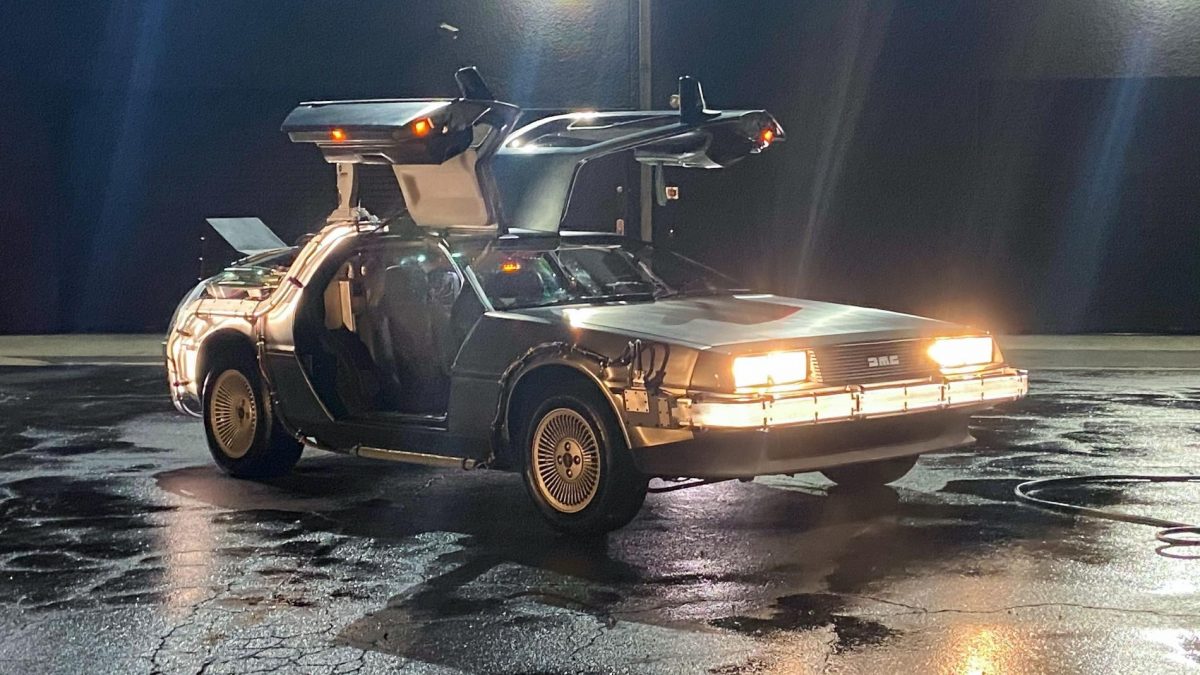
The DeLorean time machine
 The DeLorean time machine on display in 2021
The DeLorean was developed under the supervision of Lawrence Paull, who designed it with artist Ron Cobb and illustrator Andrew Probert. They intended for the vehicle to look fixed together from common parts. The time machine was originally conceived as a stationary device; at one point it was a refrigerator. Spielberg vetoed the idea, concerned child viewers might attempt to climb into one. Zemeckis suggested the DeLorean because it offered mobility and a unique design; the gull-wing doors would appear like an alien UFO to a 1950s family. The Ford Motor Company offered $75,000 to use a Ford Mustang instead; Gale responded, "Doc Brown doesn't drive a fucking Mustang". Michael Fink was hired as the art department liaison and tasked with realizing Cobb's sketches and overseeing the car's construction. He was recruited by Paull and Canton, who had worked with him on Blade Runner (1982) and Buckaroo Banzai, respectively. Fink had a project lined up but agreed to help in the free weeks he had remaining. Three DeLoreans used were purchased from a collector: one for stunts, one for special effects, and a more detailed hero version for close-up shots. They were unreliable and often broke down. 88 miles per hour (142 kilometers per hour) was chosen as the time travel speed because it was easy to remember and looked "cool" on the speedometer.
The flying DeLorean in the final scene used a combination of live-action footage, animation, and a 1:5 scale (approximately 33 inches (840 millimeters) long) model built by Steve Gawley and the model shop crew. The act of the DeLorean traveling through time was called the 'time slice' effect. Zemeckis knew only that he wanted the transition to be violent. He described it as a "Neanderthal sitting on the hood of the DeLorean and chipping away the fabric of time in front of him". The effect is so quick as to be imperceptible. Zemeckis preferred this, as he did not want the audience to think too much about how everything worked.
Art direction and makeup
.jpg) Artist Drew Struzan in 2012. He designed the Back to the Future theatrical release poster.
Artist Drew Struzan in 2012. He designed the Back to the Future theatrical release poster.
Actual brand names, such as Texaco, were used to make the sets more realistic, and the producers mandated the inclusion of certain brands that had paid to appear in the film. An unidentified gas company offered a large sum to be included, but Paull used Texaco because it reminded him of a joke from The Milton Berle Show. This choice led to some disputes, such as Pepsi parent company, PepsiCo, wanting to omit a joke about the Tab drink made by its rival Coca-Cola. Twenty clock wranglers were needed to synch up the many clocks in the opening scene, and pulleys were used to start them simultaneously. Drew Struzan produced the film's poster. The producers hoped his in-demand poster artwork would generate further interest in the film.
The film uses a stylized adaptation of the 1950s aesthetics, closer to television show interpretations than an exact recreation. Modern technologies such as contemporary fabrics were used because the designers believed the fashions of the time were not interesting. To represent characters across three decades, the filmmakers did not want to have older actors stand in for the younger ones, believing the change would be obvious and distracting. Special effects artist Ken Chase performed makeup tests on the young actors to age them; initial results were discouraging. He created a prosthetic neck and a bald cap with a receding hairline for Glover but considered them excessive. Chase found it difficult to balance aging the actors and retaining enough of their natural appearance to remain recognizable.
Casts were made of the actors' faces, from which plaster molds were made. Chase sculpted more subtle effects over the plaster molds using latex. For Lorraine, he crafted jowls and eye bags, plus body padding to reflect her increased weight and alcohol abuse. Instead of a receding hairline, Chase changed the style of George's hair; he used prosthetics only to give him a less-defined jawline.Biff's character changed more significantly because Chase wanted him to look "obnoxious"; he was fattened, given sideburns, and a comb over hairstyle to hide a growing bald spot. The prosthetics were combined with makeup and lighting to further age the characters.
Chase found the work frustrating compared to his experiences with more fantastical prostheses that made it easier to hide defects. The rubber latex did not reflect light the same way as natural skin, so Chase used a stippling process (creating a pattern with small dots) to variegate the actors' faces to better conceal where the skin and prosthetics met; close-up shots were avoided. Doc's appearance was not altered significantly. Chase painted latex on Lloyd which, when removed, caused crinkles in the skin, onto which other elements, such as liver spots and shadows, were painted.