
Classifieds site for the sale of historic, vintage, and collectible vehicles
Vintage cars for sale
Historic cars for sale
Collectible cars for sale
Vintage motorcycles for sale
NEED HELP?
help@mithosmarket.com
OPENING HOURS
Monday - Friday: 09:00 - 17:30
Saturday - Sunday: CLOSED



Ferrari Testarossa
Film Miami Vice
For other uses, see Miami Vice .
Miami Vice is an American crime drama television series created by Anthony Yerkovich and produced by Michael Mann for NBC. The series stars Don Johnson as James "Sonny" Crockett and Philip Michael Thomas as Ricardo "Rico" Tubbs, two Metro-Dade Police Department detectives working undercover in Miami, Florida. The series ran for five seasons on NBC from September 16, 1984 to June 28, 1989. USA Network began airing reruns in 1988 and broadcast a previously unaired episode during its syndication run of the series on January 25, 1990.
Unlike standard police procedurals, the show drew heavily upon 1980s New Wave culture and is noted for its integration of contemporary pop and rock music, and stylish or stylized visuals. People magazine states that Miami Vice was the "first show to look really new and different since color TV was invented".
Mann also directed a modernized film adaptation based on the series, which was released in July 2006.
Conception
The conception of the show is unclear. One version of events states that the head of NBC's Entertainment Division, Brandon Tartikoff, wrote a brainstorming memo that simply read "MTV cops", and later presented it to series creator Anthony Yerkovich, formerly a writer and producer for Hill Street Blues. Yerkovich, however, has indicated he devised the concept after learning about asset forfeiture statutes allowing law enforcement agencies to confiscate the property of drug dealers for official use. The initial idea was for a movie about a pair of vice cops in Miami. Yerkovich then wrote a script for a two-hour pilot, titled Gold Coast, but later renamed it Miami Vice. Yerkovich was immediately drawn to South Florida as a setting for his new-style police show.
Production
In keeping with the show's title, most episodes focus on combating drug trafficking and prostitution. Episodes often end in an intense gun battle, claiming the lives of several criminals before they can be apprehended. An undercurrent of cynicism and futility underlies the entire series. The detectives repeatedly refer to the "Whac-A-Mole" nature of drug interdiction,with its parade of drug cartels quickly replacing those that are apprehended. Co-executive producer Yerkovich explained:
Even when I was on Hill Street Blues, I was collecting information on Miami, I thought of it as a sort of a modern-day American Casablanca. It seemed to be an interesting socio-economic tide pool: the incredible number of refugees from Central America and Cuba, the already extensive Cuban-American community, and on top of all that the drug trade. There is a fascinating amount of service industries that revolve around the drug trade—money laundering, bail bondsmen, attorneys who service drug smugglers. Miami has become a sort of Barbary Coast of free enterprise gone berserk.
The choice of music and cinematography borrowed heavily from the emerging New Wave culture of the 1980s. As such, segments of Miami Vice sometimes used music-based stanzas, a technique later featured in Baywatch. As Lee H. Katzin, one of the show's directors, remarked, "The show is written for an MTV audience, which is more interested in images, emotions and energy than plot and character and words." These elements made the series into an instant hit, and in its first season saw an unprecedented fifteen Emmy Award nominations.[4][7] While the first few episodes contain elements of a standard police procedural, the producers soon abandoned them in favor of a more distinctive style. Influenced by an Art Deco revival, no "earth tones" were allowed to be used in the production by executive producer Michael Mann. A director of Miami Vice, Bobby Roth, recalled:
There are certain colors you are not allowed to shoot, such as red and brown. If the script says "A Mercedes pulls up here," the car people will show you three or four different Mercedes. One will be white, one will be black, one will be silver. You will not get a red or brown one. Michael knows how things are going to look on camera.
Miami Vice was one of the first American network television programs to be broadcast in stereophonic sound. It is mixed in stereo for its entire run. Each episode of the series cost $2 million.
Casting
Nick Nolte and Jeff Bridge were considered for the role of Sonny Crockett, but since it was not lucrative for film stars to venture into television at the time, other candidates were considered. Mickey Rourke was also considered for the role, but he turned down the offer. Larry Wilcox, of CHiPs, was also a candidate for the role of Crockett, but the producers felt going from one police officer role to another would not be a good fit. After dozens of candidates and a twice-delayed pilot shooting, Don Johnson and Philip Michael Thomas were chosen as the vice cops.[4] For Johnson, who was by then 34 years old, NBC had particular doubts about the several earlier unsuccessful pilots in which he starred. Jimmy Smits played Eddie Rivera, Crockett's ill-fated partner, in the pilot episode.
After two seasons, Don Johnson threatened to walk from the series as part of a highly publicized contract dispute. The network was ready to replace him with Mark Harmon, who had recently departed St. Elsewhere, but the network and Johnson were able to resolve their differences and he continued with the series until its end.
Locations
Despite the Miami setting, the producers initially planned to film the series in Los Angeles. However, by the time production began, the decision had been made to shoot in Miami itself. Many episodes of Miami Vice were filmed in the South Beach section of Miami Beach, an area which, at the time, was blighted by poverty and crime, with its demographic so deteriorated that there "simply weren't many people on the street. Ocean Drive's hotels were filled with elderly, mostly Jewish retirees, many of them frail, subsisting on meager Social Security payments. ... They were filming all over Miami Beach. ... They could film in the middle of the street. There was literally nobody there. There were no cars parked in the street". In early episodes in particular, local elderly residents were frequently cast as extras.
Some street corners of South Beach were so run down that the production crew actually decided to repaint the exterior walls of some buildings before filming. The crew went to great lengths to find the correct settings and props. Bobby Roth recalled, "I found this house that was really perfect, but the color was sort of beige. The art department instantly paints the house gray for me. Even on feature films people try to deliver what is necessary but no more. At Miami Vice they start with what's necessary and go beyond it."
Miami Vice is to some degree credited with causing a wave of support for the preservation of Miami's famous Art Deco architecture in the mid-1980s to early 1990s; and many of those buildings, among them many beachfront hotels, have been renovated since filming, making that part of South Beach one of South Florida's most popular places for tourists and celebrities.
Other places commonly filmed in the series include locations around Broward and Palm Beach counties.
Interior scenes were initially supposed to be filmed at Universal Studios in Los Angeles, but to simplify cross-country logistics, the decision was made to use the facilities of Greenwich Studios in North Miami instead, and only carry out post-production in Los Angeles. In a few scenes, particularly in earlier episodes, Greenwich Studios' rear loading dock is repeatedly used as the back room of the Gold Coast Shipping building, where the offices of the vice squad are located.
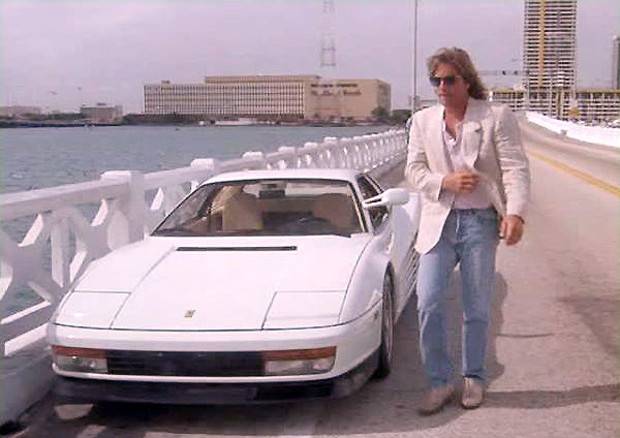
Two automobiles drew a lot of attention in Miami Vice, the Ferrari Daytona and Testarossa. During the first two seasons and two episodes of the third season, Detective Sonny Crockett drove a black 1972 Ferrari Daytona Spyder 365 GTS/4 kit replica built on a Chevrolet Corvette C3 chassis. The car was fitted with Ferrari-shaped body panels by specialty car manufacturer McBurnie Coachcraft. Once the car gained notoriety, Ferrari Automobili filed suit demanding that McBurnie and any others cease and desist producing and selling Ferrari replicas and infringing upon the Ferrari name and styling. As a result, the Daytona lasted until season 2, at which point it was "blown up" in the season three premiere episode, "When Irish Eyes Are Crying". Neither the kit car nor its backup were actually destroyed, as the production company simply blew up a small, plastic model for both cost and safety reasons. The fake Ferraris were removed from the show, with Ferrari donating two brand new 1986 Testarossas as replacements. The Ferrari Daytona is the subject of a huge continuity error on the show, when it suddenly reappears in "El Viejo", six episodes after its destruction, without explanation. Originally "El Viejo" was set to be the third season premiere, but studio executives felt the Daytona's destruction would serve as a more dramatic opening to the season. Don Johnson's contract holdout at the start of the season also played a part, delaying filming to the point where "El Viejo" could not finish in time for the season premiere.
The series' crew also used a third Testarossa lookalike, which was the stunt car. Carl Roberts, who had worked on the Daytona kit cars, offered to build the stunt car. Roberts decided to use a 1972 De Tomaso Pantera, which had the same wheelbase as the Testarossa and thus was perfect for the body pieces.The vehicle was modified to withstand daily usage on set, and continued to be driven until the series ended.
Crockett was also seen driving a black 1978 Porsche 911 SC Targa in a flashback to 1980 in the Season 3 episode "Forgive Us Our Debts."
Crockett's partner, Ricardo Tubbs, drove a 1964 Cadillac Coupe de Ville Convertible. Stan Switek drove a turquoise 1961 Ford Thunderbird. Gina Calabrese drove a 1971 Mercury Cougar XR-7 convertible. When Stan and Larry were undercover, they drove a Dodge Ram Van. Other notable vehicles that appear in Miami Vice include Lamborghinis, AMG Mercedes-Benzes, BMWs, Maseratis, Lotuses, DeLoreans, Porsches, and Corvettes. American muscle cars, such as the Pontiac GTO and Firebird Trans Am, Ford Mustang, Chevrolet Camaro, Plymouth GTX and Barracuda, Chevrolet Monte Carlo SS, and the Buick Grand National also made appearances.