
Classifieds site for the sale of historic, vintage, and collectible vehicles
Vintage cars for sale
Historic cars for sale
Collectible cars for sale
Vintage motorcycles for sale
NEED HELP?
help@mithosmarket.com
OPENING HOURS
Monday - Friday: 09:00 - 17:30
Saturday - Sunday: CLOSED



Ford Mustang GT 390 Fastback
Film Bullit 1968
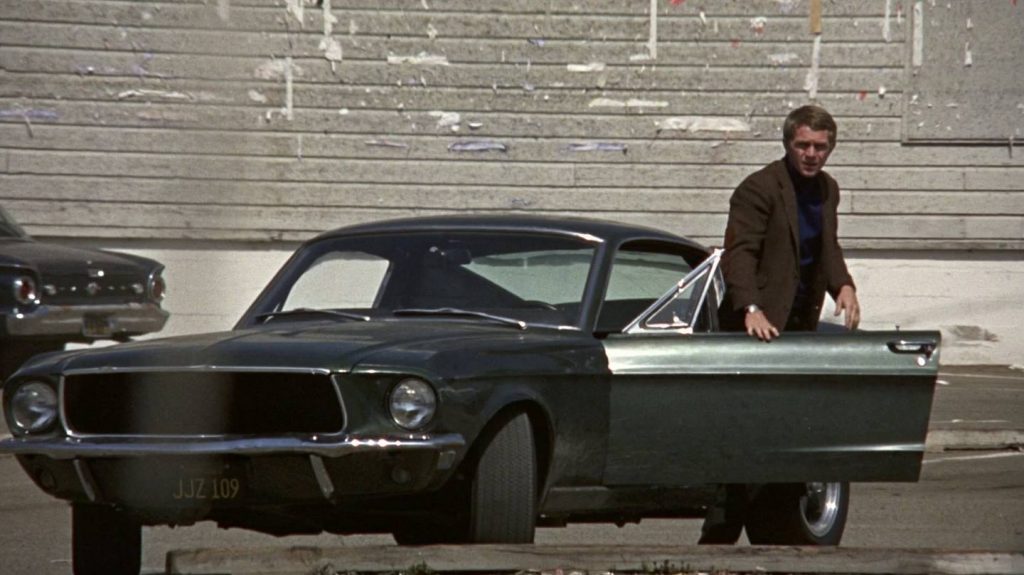
Bullitt is a 1968 American action thriller film directed by Peter Yates from a screenplay by Alan R. Trustman and Harry Kleiner and based on the 1963 crime novel Mute Witness by Robert L. Fish. It stars Steve McQueen, Robert Vaughn, Jacqueline Bisset, Don Gordon, Robert Duvall, Simon Oakland, and Norman Fell. In the film, detective Frank Bullitt (McQueen) investigates the murder of a witness he was assigned to protect.
A star vehicle for McQueen, Bullitt began development once Yates was hired upon the completion of the screenplay, which differs significantly from Fish's novel. Principal photography took place throughout 1967, with filming primarily taking place on location in San Francisco. The film was produced by McQueen's Solar Productions, with Robert Relyea as executive producer alongside Philip D'Antoni. Lalo Schifrin wrote the film's jazz-inspired score. Bullitt is notable for its extensive use of practical locations and stunt work.
Bullitt was released in the United States on October 17, 1968, by Warner Bros.-Seven Arts. It was a critical success, with praise for its screenplay, editing, and action sequences: its car chase sequence is regarded as one of the most influential in film history. The film received numerous awards and nominations, including being nominated for two Academy Awards, winning for Best Film Editing. It grossed $42.3 million worldwide, becoming one of the highest-grossing films of 1968. In 2007, Bullitt was preserved in the U.S. National Film Registry by the Library of Congress.
Plot
On a Friday night in Chicago, mobster Johnny Ross briefly meets his brother, Pete, after fleeing the Outfit. The next morning, Lieutenant Frank Bullitt of the San Francisco Police Department, along with his team, Delgetti and Stanton, are tasked by U.S. Senator Walter Chalmers with guarding Ross over the weekend, until he can be presented as a witness to a Senate subcommittee hearing on organized crime Monday morning. The detectives are told he is in a cheap hotel on the Embarcadero. At 1 a.m. Sunday, while Stanton is phoning Bullitt to say Chalmers and a friend want to come up, Ross unchains the room door. Two hitmen burst in, shooting Stanton in the leg and Ross in the chest.
Chalmers holds Bullitt responsible. After Ross dies in hospital, Bullitt sends the body to the morgue as a John Doe in order to keep the investigation open. An informant states that Ross was in San Francisco because he had stolen millions of dollars from the Outfit. Bullitt also discovers that Ross made a long-distance phone call to a hotel in San Mateo. While driving his Ford Mustang, Bullitt becomes aware he is being followed by a Dodge Charger. He eludes his pursuers, and then turns the tables as he follows the hitmen. An extended chase ensues through the city, ending in an explosion in Brisbane when the Charger crashes into a gas station, killing the two hitmen.
Bullitt and Delgetti are confronted by their superior, Captain Sam Bennett. Chalmers (who is assisted by SFPD Captain Baker) serves them a writ of habeas corpus, forcing Bullitt to reveal that Ross has died. Bennett ignores the writ because it is Sunday; this allows Bullitt to investigate the lead of the long-distance phone call to San Mateo. With no car, Bullitt gets a ride from his architect girlfriend, Cathy. The two of them find a woman garroted in her hotel room. Cathy confronts Bullitt about his work, saying, "You're living in a sewer, Frank." She wonders, "What will happen to us in time?"
Bullitt and Delgetti examine the victim's luggage and discover a travel brochure for Rome, as well as traveler's checks made out to an Albert and Dorothy Renick. Bullitt requests their passport applications from Chicago. Bullitt, Bennett, Chalmers and Baker gather around the telecopier as the applications arrive. It turns out Chalmers sent Bullitt to guard a doppelgänger, Albert Renick, a used car salesman from Chicago, while his wife Dorothy was staying in San Mateo. Bullitt realizes that Ross was playing the politically ambitious Chalmers by using Renick as a decoy so he could slip out of the country Sunday night.
Delgetti and Bullitt watch the Rome gate at San Francisco International Airport. However, Bullitt realizes the real Ross (on Renick's passport) probably switched to an earlier London flight, which is ordered to return to the terminal. Bullitt chases a fleeing Ross back to the crowded passenger terminal, where Ross guns down a deputy sheriff before being shot dead by Bullitt. Chalmers arrives to survey the scene, but leaves saying nothing. Early Monday morning, Bullitt arrives home to find Cathy asleep in his bed, having chosen to stay.
Car chase scenes
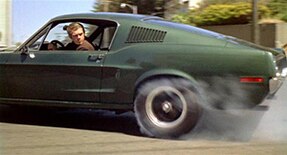 A burnout being performed in the car chase scene
At the time of the film's release, the car chase scenes featuring McQueen at the wheel in all driver-visual scenes generated prodigious excitement. Leonard Maltin has called it a "now-classic car chase, one of the screen's all-time best." Emanuel Levy wrote in 2003, "Bullitt contains one of the most exciting car chases in film history, a sequence that revolutionized Hollywood's standards." In his obituary for Peter Yates, Bruce Weber wrote, "Mr. Yates' reputation probably rests most securely on Bullitt (1968), his first American film – and indeed, on one particular scene, an extended car chase that instantly became a classic."
Filming
The chase scene starts at 1:05:00 into the film. The total time of the scene is 10 minutes 53 seconds. It begins under Highway 101 in the city's Mission District as Bullitt spots the hitmen's car. It ends outside the city, at the Brisbane exit of the Guadalupe Canyon Parkway on San Bruno Mountain. Shooting occurred over a period of weeks. The chase sequence combined several locations, located miles apart and edited together. Mapping the movie route shows that it is not continuous and is impossible to follow in real time.
Two 1968 325-horsepower 390 FE V8 Ford Mustang GT Fastbacks with four-speed manual transmissions in Highland Green were purchased by Warner Bros. for the film. The Mustangs' engines, brakes and suspensions were heavily modified for the chase by veteran car racer and technician Max Balchowsky. Ford Motor Company originally lent two Galaxie sedans for the chase scenes, but the producers found the cars too heavy for the jumps over the hills of San Francisco. They also felt a Ford-on-Ford battle would not be believable on screen. The cars were replaced with 1968 375-horsepower 440 Magnum V8 Dodge Chargers in black. The engines in the Dodge Chargers were left largely unmodified, but the suspensions were mildly upgraded to cope with the demands of the stunt work.
The director called for maximum speeds of about 130 km/h (81 mph), but the cars (including the chase cars) at times reached speeds of over 170 km/h (110 mph).
Drivers' point-of-view shots were used to give the audience a participants' feel of the chase. Filming took three weeks, resulting in 9 minutes 42 seconds of pursuit. Multiple takes were spliced into a single end product, resulting in discontinuity: Heavy damage on the passenger side of Bullitt's car can be seen much earlier than the incident producing it, and the Charger appears to lose five wheel covers, with different covers missing in different shots. Shooting simultaneously from multiple angles and creating a montage from the footage took place to give the illusion of different streets also resulted in the speeding cars passing the same vehicles at multiple times, including, as widely noted, that of a green Volkswagen Beetle.
In one scene, the Charger crashes into the camera; the damaged front fender noticeable in later scenes. Local authorities did not allow the car chase to be filmed on the Golden Gate Bridge, but did permit it in Midtown locations, including Bernal Heights, the Mission District and on the outskirts of neighboring Brisbane.
McQueen, a world-class racecar driver at the time, drove in the close-up scenes, while stunt coordinator Carey Loftin, stuntman and motorcycle racer Bud Ekins, and McQueen's usual stunt driver, Loren Janes, drove for the high-speed parts of the chase and performed other dangerous stunts. Ekins, who doubled for McQueen in The Great Escape sequence in which McQueen's character jumps over a barbed-wire fence on a motorcycle, performs a lowsider crash stunt in front of a skidding truck during the Bullitt chase. The Mustang's interior rearview mirror goes up and down depending on who is driving: When the mirror is up, McQueen is visible behind the wheel; when it is down, a stunt man is driving.
The black Dodge Charger was driven by veteran stunt driver Bill Hickman, who played one of the hitmen and helped with the chase scene choreography. The other hitman was played by Paul Genge, who played a character who had driven a Dodge off the road to his death in an episode of Perry Mason ("The Case of the Sausalito Sunrise") two years earlier. In a magazine article many years later, one of the drivers involved in the chase sequence remarked that the Charger, with a larger engine (big-block 440 cu. in. versus the 390 cu. in.) and greater horsepower (375 versus 325), was so much faster than the Mustang that the drivers had to keep backing off the accelerator to prevent the Charger from pulling away from the Mustang.